100 Envelope Savings Challenge: Save $5,050 in 100 Days (2026 Guide)
The 100 envelope savings challenge is simple on purpose: number 100 envelopes 1 to 100, draw one each day, stuff it with the matching cash — and after 100 days you have saved $5,050. It is the internet's most viral savings trick, but the $100 days demand a plan.

Key takeaways
- The 100 envelope savings challenge: number 100 envelopes 1–100, draw one daily, stuff it with that cash — after 100 days you have $5,050.
- The maths is fixed: 1 + 2 + … + 100 = $5,050, or $50.50/day. In order, week 1 costs $28 and week 14 costs $665.
- It bends to any budget: 50 envelopes ($1,275), reverse order, half amounts ($2,525), a weekly pace, or a cashless version.
- Best for gamified savers, emergency-fund builders, and cash users.
- Downsides are real: lumpy cash flow, cash at home, money earning nothing. Bank the stash weekly.
What the 100 envelope savings challenge is
Number 100 envelopes 1 to 100. Each day, pick one — randomly or in order — and tuck inside the cash written on the front: #23 gets $23, #87 gets $87. Keep going until every envelope is full.
- Number 100 envelopes 1 to 100. A marker and cheap envelopes suffice.
- Shuffle them, or do not. Random draws alternate light and heavy days; in-order is a gentle start with a brutal finish.
- Draw one daily and stuff it. The number on the envelope is the dollars that go in.
- Seal it and store it safely. Check each finished envelope off a tracker.
One envelope a day finishes in 100 days — just over three months — with $5,050 in cash. As Chime's breakdown notes, that averages $50.50 a day, and shuffling keeps high and low amounts from bunching at the end.
The maths behind the $5,050
No trick to the total — it is the sum 1 to 100: (1 + 100) × 100 ÷ 2 = $5,050. Random or in order, the total never changes; only the shape of the journey does:
| Week | Days | Stuffed (in order) |
|---|---|---|
| Week 1 | 1–7 | $28 total |
| Week 7 | 43–49 | $322 total |
| Week 14 | 92–98 | $665 total |
| Final two days | 99–100 | $199 total |
The average hides that shape: in order, the last 28 envelopes hold nearly half the entire $5,050. Shuffling spreads the pain — any day can demand $1 or nearly $100 — but the daily ask never changes. Plan for the heavy days before they arrive.
Six variations that fit real budgets
Not every budget fits $5,050 in 100 days — the challenge is openly adjustable:
- 50-envelope version. Envelopes 1 to 50: $1,275 in 50 days — a first win before the full hundred (SuperMoney's variation guide).
- Reverse order. From #100 down to #1: hardest days first, while motivation is highest.
- Half amounts. Stuff half each number — #50 gets $25, #100 gets $50. Total: $2,525.
- Weekly version. One envelope a week: 100 weeks, about 23 months, roughly $7.21/day on average.
- Digital/cashless. Track with the envelopes, transfer each draw into a savings account. No theft risk, and the money can earn interest. See our best personal finance apps for tracking help.
- Double-up. Twice each number — $2 in #1 up to $200 in #100. Total: $10,100.
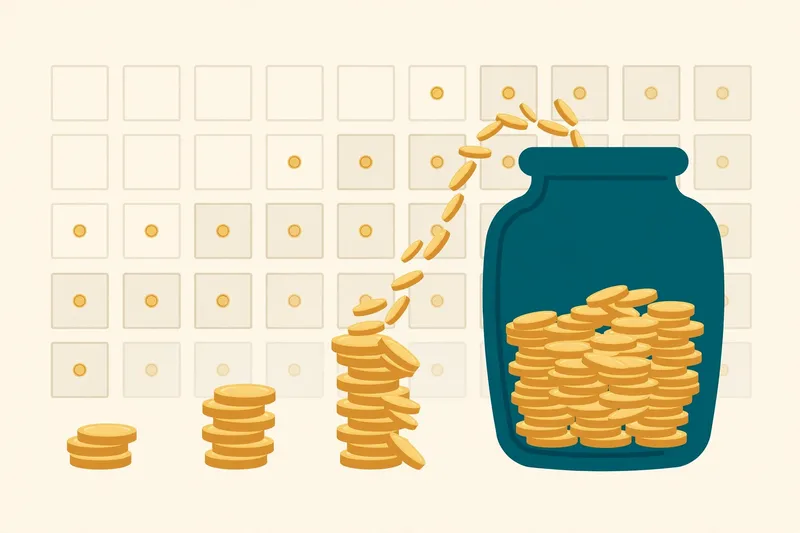
Who the 100 envelope savings challenge is actually for
Not for people who already save on autopilot — for gamified savers who need a daily ritual and a visible finish line; for emergency-fund builders, since $5,050 is a genuine cushion (the CFPB's Start Small, Save Up initiative found even small amounts of liquid savings can make a big difference); and for cash users who save better with money they can hold.
The psychology is real: one analysis of the challenge cites Bayes Business School research suggesting gamified saving can lift goal completion by nearly 20% — daily tasks, visible progress, and a clear finish line turn saving into a game. New to the basics? Start with what is personal finance.
The honest pitfalls
Four sharp edges the social media version skips:
- Lumpy cash flow. The $50.50 average misleads: one week can bring a $9 Tuesday and a $94 Thursday. Keep a small cash buffer before you begin.
- Cash at home. A finished challenge is $5,050 in bills exposed to theft or fire. SoFi's advice: deposit the cash into your savings account regularly during the challenge.
- Interest lost. Cash in envelopes earns exactly zero. The digital variation above fixes this completely.
- Hype vs. reality. TikTok shows the stuffing montages, not the $97 draw in rent week. As budgeting expert Andrea Woroch notes in BuzzFeed's expert roundup, the real win is behavioral — treat $5,050 as the ceiling, not a promise.
How to start it (and actually finish)
- Fund a cash buffer on payday so heavy draws never force an emergency ATM run.
- Bank weekly: deposit filled envelopes into savings; progress stays visible on the tracker.
- Track on a visible 1–100 grid — celebrate 25, 50, and 75.
- Miss a day? Keep going — consistency beats a broken streak.
- Recruit a rival — a partner or friend adds accountability and friendly competition.
The verdict
One of the best entry-level savings tools going: simple, visual, fun, and capable of a real $5,050 emergency fund in just over three months. Manage the flaws — shuffle the draws, pick a fitting variation, bank weekly. When the envelopes are gone, keep the habit: point it at your balances with our debt snowball sheet.
$5,050 toward debt instead?
Run your balances through the snowball and watch the payoff order.
Try the debt snowball sheetSources & further reading
How-to and variation figures from the cited sources; worked arithmetic is our own, computed in Python.
- Chime — 100 Envelope ChallengeHow it works, in-order vs. random, $5,050 total, $50.50/day average.
- SoFi — 8 Fun Money Savings ChallengesThe 100-day format; deposit cash regularly, not at home.
- SuperMoney — 100 Envelope ChallengeVariation maths: half $2,525, weekly ~$7.21/day, 50-envelope $1,275, double $10,100.
- BuzzFeed — Is the 100 Envelope Challenge a Good Way to Save?Expert views from Ally, Credit Karma, and Andrea Woroch.
- CFPB — Start Small, Save UpSmall amounts of liquid savings make a big difference.
- Brain Fodder — Psychology of the TikTok Saving ChallengeGamification and the cited Bayes Business School finding.