How Long to Pay Off Credit Card Debt? Timelines, Costs and What Speeds Them Up
How long it takes to pay off credit card debt comes down to three numbers — and one matters more than the other two combined. A $5,000 balance at 24.7% APR can take anywhere from nearly twenty years to under two. Here are the real timelines, the real costs, and the habits that change them.
Key takeaways
- Three numbers set your payoff date: the balance, the APR, and how much you pay above the minimum — the third matters most.
- On $5,000 at 24.7% APR: minimums take ~19 years, ~$8,989 interest; $200/month takes ~3 years, $2,095; $300/month takes ~21 months, $1,187.
- At 24.7%, a flat 2% minimum does not cover that month’s interest — the balance grows, so the card is never paid off.
- Two-card race ($3,000 at 27% + $1,500 at 19%, $300/month): avalanche: 18 months, $859 interest; snowball: 19 months, $1,019.
- Interest accrues daily on the average daily balance — freeze new charges on the card you are paying down; aim every extra dollar at one card.
The three numbers that set your payoff date
The Federal Reserve’s G.19 release puts the average rate on accounts charged interest at 22.15%, though individual cards routinely price higher (Federal Reserve G.19).
The formula is n = −ln(1 − rB/P)÷ln(1+r), where B is the balance, P the monthly payment, and r the monthly rate (APR ÷ 12): each payment covers interest first, then shrinks the balance. The catch: it only works when your payment exceeds that month’s interest (P > rB) — pay less and the balance grows instead.
Of the three, the payment moves the needle most: cutting your APR five points (24.7% to 19.7%) saves about $600 in interest on the $200 plan, while adding $100 to the payment saves over $900. Extra principal stops accruing interest immediately.
Worked example: $5,000 at 24.7% APR
The same $5,000 balance under three plans — the minimums row uses a typical issuer formula (that month’s interest plus 1% of the balance, $25 floor), simulated month by month:
| Payment plan | Months to zero | Total interest paid |
|---|---|---|
| Minimums only* | 232 (about 19.3 years) | ~$8,989 |
| $200/month fixed | ~36 (about 3 years) | ~$2,095 |
| $300/month fixed | ~21 (about 1.75 years) | ~$1,187 |
The gap is the story: $300 a month clears the debt 17 and a half years sooner than minimums and avoids roughly $7,800 in interest — over one and a half times the original balance. And the first minimum here is about $154: the $200 plan costs only $46 more a month yet finishes roughly sixteen years sooner.
The minimum-payment trap: what the warning box means
Every card statement carries a minimum-payment warning box: how long your balance takes at minimums only, and what clears it in 36 months — required by the CARD Act, and the CFPB explains what those figures assume (CFPB). On our $5,000 example, the 36-month figure is about $198 a month , barely above the $200 plan.
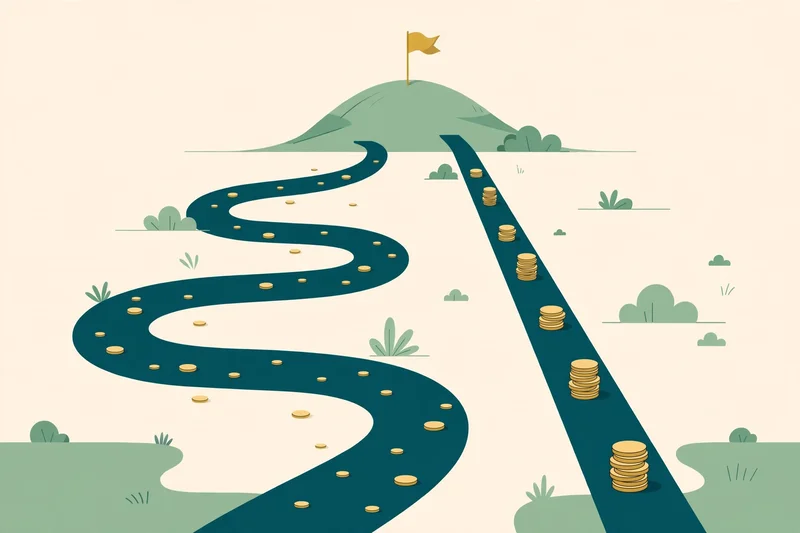
The darker version: some cards set the minimum as a flat percentage — say 2%. At 24.7% APR, one month’s interest is about 2.058% of the balance, so a 2% minimum does not cover the interest: the unpaid part is added back, negative amortisation, and the balance rises forever. Issuers usually use interest-plus-percentage formulas instead — hence 19 years, not infinity — but minimum payments are a compliance floor, not a plan: the payment shrinks as the balance shrinks, dragging the schedule through years of small payments that are still mostly interest. That is how $5,000 quietly costs $8,989 in interest alone.
Avalanche vs snowball: a two-card race
With more than one card, the payoff order changes the timeline. Two strategies dominate — see NerdWallet’s debt payoff guide: the avalanche (minimums everywhere, everything extra at the highest rate first) and the snowball (same, but targeting the smallest balance first).
Two cards — $3,000 at 27% and $1,500 at 19% — with $300 a month total:
- Avalanche (attack the 27% card first): debt-free in 18 months, $859 in total interest.
- Snowball (clear the $1,500 card first): debt-free in 19 months, $1,019 in total interest.
The avalanche wins on both axes: one month sooner, $160 less interest — the highest rate is the costliest fire. The snowball’s case is psychological: clearing the $1,500 card gives a quick win that keeps some people going. Pick the one you will stick with — a finished snowball beats an abandoned avalanche — and once the first card dies, roll its whole payment into the next.
One warning on consolidation: rolling card debt into a balance-transfer card or cash-out refinance only works if spending changes too — our refinance rule-of-thumb guide cites a CFPB study finding most borrowers ran balances back up within five quarters.
Stop the balance from growing while you pay it down
The timeline maths assumes no new charges. Interest accrues daily, and once you carry a balance, new purchases usually accrue interest immediately — the grace period only applies when you pay in full. Five habits keep the timeline honest:
- Freeze new charges on the card you are paying down — pay with debit or cash instead.
- Autopay at least the minimum on every card. — a missed payment triggers late fees and can reset your APR to a penalty rate near 30%.
- Pay more than the minimum on the target card only — minimums on the rest, every extra dollar on one card.
- Call your issuer once and ask for a lower rate — a few points shaved off shortens the schedule at no cost.
- Keep a small emergency fund — even $500 — or every surprise expense lands back on the card.
- Track the principal, not the payment — our personal finance app roundup covers trackers that show real balances and payoff progress.
The bottom line: your payoff date is set by the gap between your payment and the minimum. Once the balance hits zero, redirect that payment into savings: our compound interest calculator shows what it becomes over a decade.
Sources & further reading
- Federal Reserve G.19 Consumer Credit release — the quarterly source for average credit card APRs; 22.15% for accounts assessed interest in the latest published reading.
- CFPB: what the minimum-payment box on your statement means — how the payoff-time and 36-month figures are calculated, and what counts toward them.
- NerdWallet: How to Pay Off Debt, top strategies for 2026 — the avalanche and snowball methods explained with worked examples.