What Is Personal Finance? A Beginner’s Guide for 2026
Personal finance is the least taught and most used subject of your life. Every decision after your first paycheck — where you live, how you sleep, when you can stop working — runs through it. It is simpler than the industry makes it look. Five pillars, one sensible rule of thumb, and habits you can start this week.
Key takeaways
- Personal finance is how you earn, spend, save, invest and protect your money — five pillars working as one system.
- The 50/30/20 rule: on a $4,700 monthly take-home, roughly $2,350 for needs, $1,410 for wants, $940 for saving and debt payoff.
- Build an emergency fund before investing seriously — guidance is three to twelve months of living expenses, kept somewhere safe.
- Starting small beats waiting: consistent contributions plus compound interest do most of the heavy lifting.
The simple definition
Strip away the jargon and personal finance means this: planning how you earn money, spend it, save it, invest it and protect it, so you can cover today’s life and tomorrow’s goals at the same time.
The key word is planning: decisions repeated monthly that compound in your favour or against you. US household debt hit $18.8 trillion in Q1 2026 (Federal Reserve Bank) — proof that even high earners go backwards without a plan.
The five pillars, in plain English
Investopedia organises the subject into five areas, and they make a good mental map:
- Income — everything flowing in: salary, wages, freelance work, dividends. Know your actual take-home pay after taxes and withholding — every budget is built on the net figure, not the gross.
- Spending — everything flowing out: rent, groceries, transport, hobbies. This is where most income goes, and the whole discipline can be summarised as spend less than you earn.
- Saving — income left over after spending, parked for large expenses and emergencies. The aim is a buffer, not a pile: cash beyond your emergency fund loses purchasing power to inflation sitting idle.
- Investing — putting money into assets such as stocks, bonds and mutual funds so it grows faster than inflation. The SEC’s Investor.gov is essential reading before you start — investing aims to grow wealth, but not every asset appreciates.
- Protection — insurance and planning for the shocks you cannot budget away: illness, accidents, loss of income. Life, health and disability cover sit here, alongside a will.
Notice how the pillars connect. Spending discipline creates savings; savings fund investing; protection keeps one bad month from demolishing the other four.
The 50/30/20 rule, worked on a real paycheck
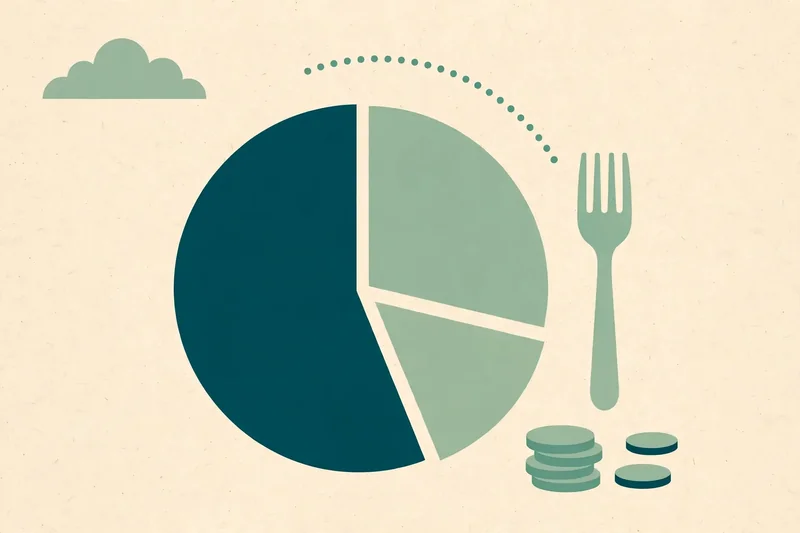
Beginners need a starting split, and the 50/30/20 rule is the most useful one in personal finance: 50% of take-home pay for needs, 30% for wants, 20% for saving and debt payoff.
Put it on a real paycheck. A $75,000 salary lands at roughly $4,700 a month after tax in a typical US state (run your own numbers in our salary calculator):
- 50% — needs: ~$2,350. Rent or mortgage, utilities, groceries, transport, minimum debt payments. If needs eat 60%+, the problem is usually housing or car costs, not coffee.
- 30% — wants: ~$1,410. Dining out, travel, subscriptions, hobbies. The first valve you turn when money is tight.
- 20% — future you: ~$940. Emergency fund, extra debt payments, retirement accounts.
Treat it as scaffolding, not scripture. High-cost cities may need 60/25/15; aggressive debt payoff may flip wants and savings.
Where beginners usually go wrong
1. Budgeting the gross, not the net. A $75,000 salary is not $6,250 a month to spend — taxes and FICA take their cut first. Budget take-home pay.
2. Investing before the emergency fund. Three months of expenses in savings is what stops a broken transmission from becoming credit-card debt at 20%+ interest. Build the buffer first.
3. Letting lifestyle absorb every raise. If spending rises one-for-one with income, the savings rate never moves — and the savings rate, not the salary, decides when you can retire.
A 30-minute starter plan
You do not need a complicated spreadsheet. Thirty focused minutes:
- Minutes 0–10: write down monthly take-home pay and list every fixed bill. Subtract. What is left is your real budget.
- Minutes 10–20: open a separate savings account and set an automatic transfer for your 20% (or whatever you can manage) the day after payday. Automation beats willpower.
- Minutes 20–30: check your retirement account. Fidelity’s guideline: save 15% of income a year from your mid-twenties, toward 10x your salary by 67. If your employer matches 401(k) contributions, capture the full match — it is free money.
Then leave it alone for a month and review. It is a system you tune, not a test you pass once.
Watch small contributions grow
See what your 20% becomes over 10, 20 or 30 years with monthly contributions and compound growth.
Open the compound interest calculatorSources & further reading
Every external figure in this guide comes from one of these. The worked examples are our own arithmetic, shown in full above.
- Investopedia — What Is Personal Finance, and Why Is It Important?The five areas; the 50/30/20 split; emergency fund of 3–12 months; US household debt $18.8 trillion in Q1 2026 (Federal Reserve Bank).
- U.S. Securities and Exchange Commission — Introduction to Investing (Investor.gov)Investing basics: what it is, that it aims to grow wealth, and that not all assets appreciate.
- Fidelity — How much do I need to retire?Save 15% of income annually from age 25; milestones of 1x salary by 30, 3x by 40, 6x by 50, 8x by 60, 10x by 67.
Frequently asked questions
What is personal finance in simple words?
Personal finance is how you manage your own money: earning it, spending it, saving it, investing it and protecting it. It is a plan for covering today’s expenses and tomorrow’s goals at the same time.
What are the five components of personal finance?
Income, spending, saving, investing and protection (insurance and estate planning). They work as a system: spending discipline creates savings, savings fund investing, and protection keeps one bad month from undoing the rest.
What is the 50/30/20 rule?
A budgeting rule of thumb: 50% of take-home pay for needs, 30% for wants and 20% for savings and debt payoff. Adjust the split to your city and goals.
How much of my paycheck should I save?
Investopedia’s experts suggest roughly 20% of each paycheck; Fidelity’s retirement guideline is 15% of income a year from your mid-twenties. Start with whatever you can automate and raise it with each pay rise.
Do I need a financial advisor to manage personal finance?
Not at first. Budgeting, an emergency fund and automatic retirement contributions are DIY-friendly. Consider an advisor later, when a big decision (house, business, inheritance) is on the table.