Put a lump sum toward your mortgage and watch your monthly payment drop — without touching your rate or your payoff date.
New monthly payment
—
after the lump sum is applied
Monthly savings
—
Total interest saved
—
Recast fee estimate
—
Recast vs refinance (same loan, two routes to a lower payment)
Recast
Refinance
What a mortgage recast actually is
A mortgage recast is not a new loan — it is a re-calculation of the loan you already have. You hand your servicer one large lump-sum payment toward principal (minimums are often $5,000 to $10,000), and they re-amortise your new, smaller balance over your existing remaining term at your existing interest rate. The result: a lower monthly payment, less total interest, and a payoff date that never moves. There is no appraisal, no underwriting and no credit pull — most servicers charge a one-time recast fee of just $150 to $500 (Bankrate), which the calculator above applies automatically.
The numbers: a $50,000 recast on a $300,000 balance
Take the calculator's defaults: a $300,000 balance at 7.28% with 25 years left costs $2,174.22 a month in principal and interest. Drop a $50,000 lump sum on it and the balance falls to $250,000 — re-amortised over the same 25 years, the payment drops to $1,811.85. That is $362.37 saved every month, and over the remaining term you pay $58,711 less in interest than you would have. Total remaining payments fall from $652,267 to $543,856 (including the $300 recast fee) — the split you can see in the donut chart above.
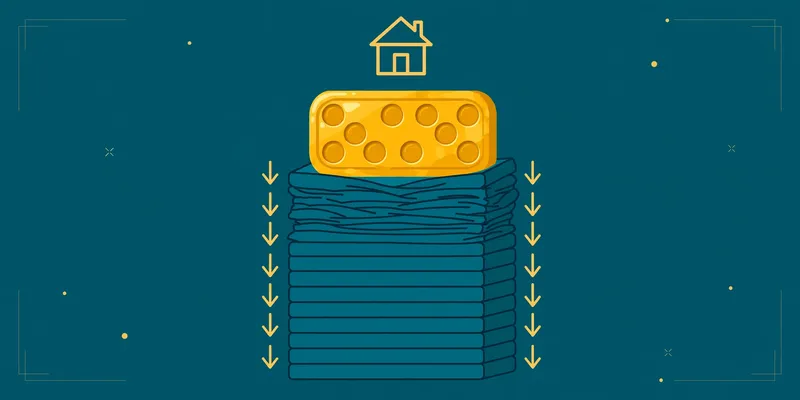
One lump sum compresses the whole payment stack: same rate, same term, smaller balance, lower payment.
Recast vs refinance: which one wins for you
The table above lays out the trade-off, but the decision comes down to two questions. Do you like your rate? A recast keeps it; a refinance replaces it. At 7.28% or below, most borrowers are better off recasting — there is no reason to pay thousands in closing costs to replace a rate you already like. Do you have the lump sum? A recast needs it; a refinance does not. Refinancing typically runs 2% to 5% of the loan amount in closing costs (Bankrate) — $6,000 to $15,000 on a $300,000 balance — plus weeks of paperwork. Our refinance rules-of-thumb guide walks through the 1% rule and the break-even maths if a refinance is on your mind.
A few hundred dollars against up to fifteen thousand: the upfront-cost gap is why the break-even race is no contest.
Who doesn't qualify (and why)
Recasting is optional for servicers — not all of them offer it, so your first call is always to yours. It is also usually limited to conventional loans: government-backed mortgages, including FHA, VA and USDA loans, generally cannot be recast (Bankrate). Expect a minimum lump-sum requirement, commonly $5,000 to $10,000, and a clean record of on-time payments. If a recast is not on the table for you, start with our mortgage calculator — knowing your current payment and rate is the starting point for whichever route you take next.
Frequently asked questions
What is a mortgage recast?
A recast is a one-time lump-sum payment toward your mortgage principal — often $5,000 to $10,000 minimum — after which your servicer re-amortises the remaining balance over your existing term at your existing rate. Your monthly payment drops, but your rate and payoff date stay exactly the same. It is far cheaper than refinancing because there is no new loan, appraisal or underwriting.
How much does it cost to recast a mortgage?
Most servicers charge a one-time recasting fee between $150 and $500, and some charge nothing at all — that is the entire upfront cost. Compare that with a refinance, which typically runs 2 to 5 percent of the loan balance in closing costs. The calculator above uses a $300 fee estimate, the midpoint of the common range, so you can see how small that cost is next to your savings.
Should I recast or refinance my mortgage?
Recast when you like your current rate and have a lump sum: the fee is tiny, your rate and term stay put, and your payment drops with almost no paperwork. Refinance when your rate is high and a new market rate could beat it — the interest savings on the full balance can outweigh the closing costs, especially if you will stay in the home well past the break-even point.
Does recasting shorten my loan term?
No. A recast keeps your original payoff date — the servicer simply spreads the smaller balance over the same remaining term, which is what lowers your payment. If you want the term to shrink too, keep paying the old, higher amount after the recast; that extra goes straight to principal and can shave years off the loan while building equity faster.
Which loans can be recast?
Recasting is usually limited to conventional loans, and not every servicer offers it — always ask yours first. Government-backed loans including FHA, VA and USDA mortgages generally cannot be recast, and most servicers require a minimum lump sum, commonly $5,000 to $10,000, plus a clean record of on-time payments.