What Happens If You Miss a Credit Card Payment: Timeline
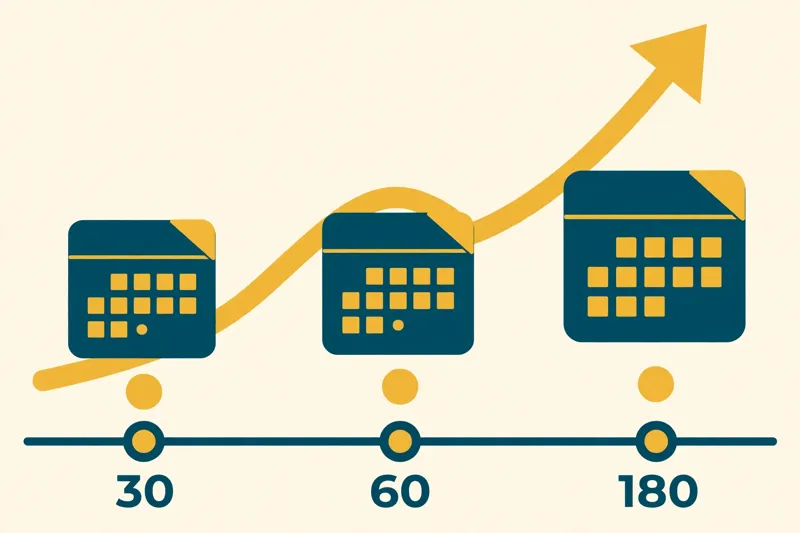
A missed credit card payment does not punish you all at once. It sets off a chain reaction: a fee first, a mark at 30 days, a higher rate at 60 days, and a charge-off months later.
Key takeaways
- One day late usually means a fee, not credit damage: issuers generally do not report a miss until 30 days past due.
- At 30 days, the miss can stay on your reports up to seven years.
- At 60 days, a penalty APR near 30% may apply.
- At around 180 days, the issuer may charge it off — but you still owe it.
The timeline at a glance
| When | What happens | Your best move |
|---|---|---|
| Day 1 | Late fee; grace period lost | Pay the minimum |
| Days 2–29 | Fees build; no report yet | Catch up in full |
| Day 30 | Reported to bureaus | Pay up; stay current |
| Day 60 | Penalty APR may apply | Ask for hardship help |
| Day 90 | Account may be closed | Negotiate a plan |
| Day 120–180 | Charge-off; collections | Get any plan in writing |
Day 1: the fee lands and the grace period ends
The due date is a hard deadline: if at least the minimum has not arrived by the cutoff time, the account is late and a fee can follow. Federal safe-harbor amounts allow up to $30 for a first late payment and up to $41 for a later one within six billing cycles, as NerdWallet explains — your card agreement states your exact fee.
A partial payment does not save you: less than the minimum due still counts as late. Missing the due date can also end your grace period, so new purchases may accrue interest immediately. Ignore claims of an $8 cap: the Consumer Financial Protection Bureau's $8 rule was vacated by a federal court in April 2025, leaving the older $30 and $41 amounts in place, as BestMoney reports. Pay at least the minimum now, then ask for a one-time fee waiver on a first miss.
Days 2–29: the window where you can still stop the damage
Nothing has reached your credit report yet: Equifax notes that late payments generally will not end up on your credit reports for at least 30 days after you miss the payment, although late fees may already apply. Some issuers wait until 60 days, but never count on that. Use this window to catch up in full if you can, and confirm the account shows as current. If money is short, call before day 30 about a hardship program, which can lower your rate or pause fees. Then set autopay for at least the minimum.
Day 30: the miss reaches your credit report
Once a payment is 30 days past due, the issuer can report it to Experian, Equifax, and TransUnion, and that mark can stay on your reports up to seven years. Payment history is the largest FICO factor, at 35%, so a reported late payment can hurt. Experian gives the example of someone with excellent credit seeing scores fall roughly 60 to 80 points from a single payment at least 30 days late. The damage is worst when fresh and fades over time, so catching up at day 31 beats drifting to day 60 — and do not close the account in anger, since that can raise utilisation.
Day 60: the penalty APR can kick in
At 60 days late, the issuer may apply a penalty APR, a much higher rate near 30% or more, possibly on your existing balance as well as new purchases. Credit Karma notes that a penalty APR is often as high as 29.99%, and any 0% introductory offer can be cancelled too. The issuer may also freeze your line of credit until you catch up. Ask now whether a hardship program can restore a lower rate or spread the past-due amount over months, and size a plan with our guide to how long it takes to pay off credit card debt.
Day 90: the account itself is at risk
By 90 days — three missed cycles — the issuer may close your account altogether. Closure does not erase the debt: you still owe the full balance, and it can hurt your scores by raising utilisation. Expect calls and letters to intensify while fees stack up. If closure happens, or you are considering it yourself, read our guide on how to close a credit card first, so you understand the trade-offs. During delinquency, keeping the account open and current usually beats closing it.
Day 120–180: charge-off and collections
If the account goes unpaid for around 180 days, the issuer will typically charge it off, writing the debt off its own books as a loss. A charge-off is not forgiveness: you still owe the money, and it appears on your reports. The issuer may also sell the debt to a collection agency. At this stage, written records matter most: ask any collector for written validation, keep copies of every letter, and get any settlement in writing before you pay. Never agree to a payment you cannot sustain; if several accounts are delinquent, consider a nonprofit credit counsellor.
After the miss: rebuilding, and can it be removed?
Recovery is slow but real: the mark stays up to seven years, but its impact fades after a year or two of on-time payments. Pay every bill on time, keep balances low, and let new positive history outweigh the old mark. Once current again, our guide on how to use a credit card covers the autopay system that prevents a repeat. If the late payment is genuinely inaccurate, dispute it with the bureaus, who must investigate — but a dispute will not remove an accurate one. For that, try a goodwill letter: a short request to the issuer asking it to remove the mark as a courtesy. As NerdWallet explains, creditors need not agree, but a first, isolated miss on a clean, now-current account is most likely to succeed. The earlier you act, the cheaper the mistake.
This article is general information only and is not financial advice. Card terms and fees vary by issuer, so check your cardholder agreement.