How to Close Credit Card: 7 Steps That Protect Your Score
How to close credit card accounts the right way: pay to zero, redeem rewards, reroute autopays, close in writing — with the utilization math that protects your score.
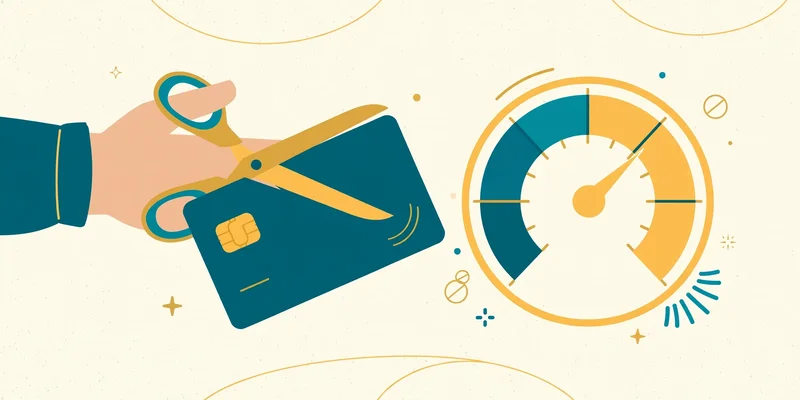
Cutting up a credit card feels like closing it. It is not: the account stays open until you tell the issuer, in a recorded request, to shut it down. Done right it costs minutes; done sloppily you can forfeit rewards, trigger stray charges, and dent your score for nothing.
Here is the exact sequence — pay to zero, rescue rewards, reroute autopays, close and confirm in writing — plus the utilization math most people skip and the two alternatives (a downgrade, a retention offer) to ask about first.
When closing a credit card is the right call
Close when the card costs more than it gives: an annual fee on unused benefits, or service you are done with. Hold off if it is your only or oldest card, or you carry balances elsewhere — and if a mortgage or car loan is coming soon, wait until after it closes.
How to close a credit card in 7 steps
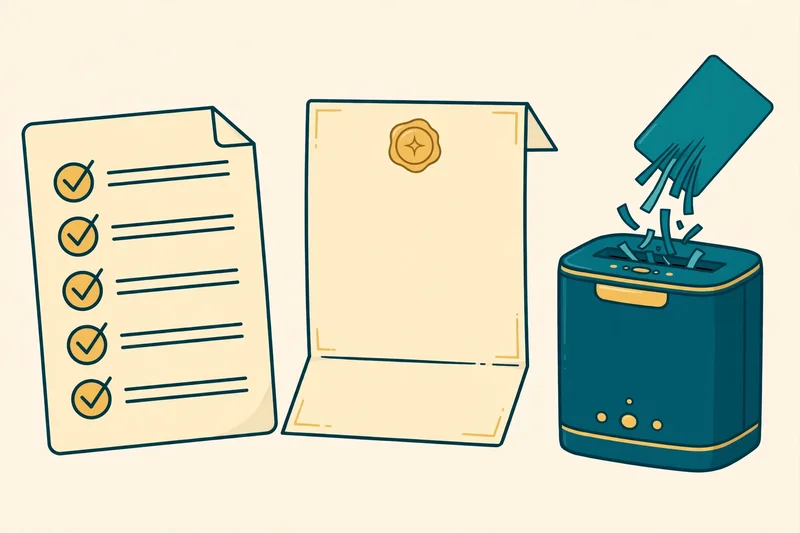
Follow this order and nothing falls through the cracks:
- Pay the balance to zero first. Closing never erases debt — interest keeps accruing on a closed account (Discover). Too big to clear today? Our credit card payoff calculator shows your debt-free date, and a debt snowball sheet organizes the attack.
- Redeem every reward. Unredeemed points and cash back usually vanish at closure, and some programs enforce a minimum redemption (Capital One). Take cash back as a statement credit or transfer points to a partner program.
- Reroute autopays and subscriptions. Move streaming, utilities, the gym — every recurring charge — to a card you are keeping (Discover); charges can still post after closure.
- Tell authorized users. Warn any spouse or family member with a card on the account before you close (Discover).
- Ask about a downgrade or retention offer first. If the annual fee is the problem, ask for a waiver or a downgrade to the no-fee version of the same card — you keep the limit and the history (Quicken Loans). Only close if the answer is no.
- Make the request — and get it in writing. Call the number on the back of the card, use the issuer’s online close flow, or mail a certified letter; then request written confirmation (Discover). Closing is free (Capital One).
- Destroy the card. Cut it up or shred it so the number cannot be lifted or reused.
How closing affects your credit score: the utilization math
Closing hits two parts of your score. The big one is credit utilization — balances divided by total limits — which feeds the amounts-owed slice worth about 30% of a FICO score (Quicken Loans). Closing deletes the card’s limit from the denominator, so the same balances look bigger; experts want utilization under 30% (Experian).
The math, worked out — $2,000 in balances, $10,000 in combined limits:
Before closing: $2,000 ÷ $10,000 = 20% utilization — comfortably under the 30% line.
After closing the $5,000-limit card: $2,000 ÷ $5,000 = 40% utilization — the same debt now reads as risky.
The second channel is account age, worth about 15% of a FICO score (Quicken Loans). But a closed account in good standing stays on your report for up to 10 years and keeps aging, so the hit is delayed, not instant (NerdWallet) — pay down other balances first and any dip is usually small.
Smarter alternatives to closing
First, the downgrade: most issuers will switch you to the no-annual-fee version of the same card — same history, same limit, zero fee. Second, the retention offer: say you are thinking of leaving and they may waive the fee or add bonus points. If the card is already fee-free, try the sock-drawer strategy: one small recurring charge, autopay in full, and it quietly holds your utilization down. Broader rebuild? See how to build credit without a credit card.
Check your credit report after closing
After one to two billing cycles, pull your reports from all three bureaus: the account should read “closed at consumer’s request” with a $0 balance — dispute anything else. Good-standing accounts stay visible up to 10 years; negative marks linger seven years from the first late payment, and closing never erases them (Experian).
Key takeaways
- Cutting up the card closes nothing — only a recorded request to the issuer does.
- Pay to $0 and redeem rewards before you close; both are nearly impossible to fix after.
- Reroute every autopay and warn authorized users — charges can still post after closure.
- Run the utilization math: $2,000 on $10,000 of limits is 20%; closing a $5,000-limit card doubles it to 40%.
- Ask for a downgrade or retention offer first — keeping the limit and history usually beats closing.
- Check all three credit reports after one to two billing cycles; good-standing accounts stay visible up to 10 years.
Map your payoff before you close
If a leftover balance is all that stands between you and closing, enter it here for your debt-free date and total interest.
Open the payoff calculatorSources & further reading
Every external figure in this guide comes from one of these. The worked examples are our own arithmetic, shown in full above.
- ExperianUtilization-doubling example; keep utilization under 30% (curl: 200, 21 Oct 2026).
- ExperianGood-standing accounts visible up to 10 years; negative marks 7 years (curl: 200, 21 Oct 2026).
- NerdWalletClosed accounts keep aging; $2,000-on-$20,000 utilization example (curl: 200, 21 Oct 2026).
- DiscoverClosure checklist: pay off, redeem rewards, reroute autopays, written confirmation (curl: 200, 21 Oct 2026).
- Capital OneNo fee to close; redeem rewards first; balance remains owed (curl: 200, 21 Oct 2026).
- Quicken LoansUtilization is about 30% of a FICO score; 16.7%-to-50% worked example (curl: 200, 21 Oct 2026).