50/30/20 Budget Rule: How to Split Every Paycheck Wisely
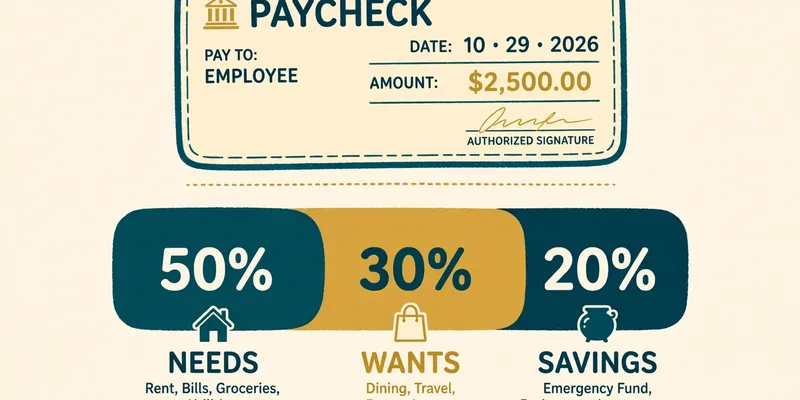
The 50/30/20 budget rule splits take-home pay into three buckets: 50% needs, 30% wants, 20% savings and extra debt payments. Five minutes to set up, and every dollar gets a job.
Key takeaways
- The 50/30/20 rule splits after-tax income: 50% needs, 30% wants, 20% savings and debt repayment.
- Minimum debt payments are needs; anything above the minimum counts toward the 20%.
- The rule is a starting point, not a straitjacket: adjust it when rent or income breaks the split.
- Automating the 20% on payday is what turns the rule from a plan into a habit.
What the 50/30/20 budget rule is
The 50/30/20 budget rule is a simple framework: divide your take-home pay into three buckets. Half goes to needs, the costs you must pay to live and work. Thirty percent goes to wants, the spending that makes life enjoyable but is not essential. The rest goes to savings and extra debt payments.
The rule was popularised by Elizabeth Warren and Amelia Warren Tyagi in their 2005 book All Your Worth, where they called it the Balanced Money Formula. Its appeal is simplicity: instead of tracking every coffee, you watch just three numbers. The percentages apply to after-tax income, not your headline salary. If you earn $60,000 a year but take home $4,000 a month, the rule works on $4,000.
A worked example: $4,000 a month take-home pay
On $4,000 of monthly take-home pay:
| Bucket | Share | Amount |
|---|---|---|
| Needs | 50% | $2,000 |
| Wants | 30% | $1,200 |
| Savings and debt | 20% | $800 |
The maths checks out: $2,000 + $1,200 + $800 = $4,000. Try your own numbers the same way, multiplying take-home pay by 0.5, 0.3, and 0.2. Where the results differ from your real spending, that gap shows which bucket is overflowing.
What counts as a need, and what counts as a want
Sorting spending honestly is the hardest part: the line between needs and wants is rarely clean. Needs are costs you must pay to live and work: rent or mortgage, utilities, groceries, transport, insurance, childcare, and minimum debt payments. Minimum payments are needs: missing them damages credit and triggers fees. Anything above the minimum belongs in the 20%.
The grey areas are where most budgets quietly break. Groceries are a need; dining out is a want. A basic phone plan is a need; the premium upgrade is a want. A gym membership is a want unless your job depends on it. A useful test: if skipping it for a month would cost you your home, your job, your health, or your credit score, it is a need. Everything else, however essential it feels, is a want. Relabelling wants as needs to reach 65% only hides the spending squeezing your savings.
How to apply the rule in 3 steps
Step 1: Find your take-home pay. Use what hits your bank account after tax and deductions, or a three-month average if pay varies. Never use gross salary: budgeting money you never receive is the fastest way to overspend.
Step 2: Sort last month's spending into the three buckets. Label each transaction on last month's bank and card statements as a need, a want, or savings. It takes about half an hour. A ready-made Google Sheets budget template makes it quicker and gives you a reusable sheet for next month. Most people find one surprise want, often subscriptions or delivery food, eating far more than guessed.
Step 3: Automate the 20% before you can spend it. On payday, move the savings portion out of checking automatically. Our guide to starting multiple savings accounts shows how to split that 20% across goals. For a specific treat, such as a holiday, a sinking fund keeps the goal funded without raiding it early. Automation beats willpower, which is unreliable once the money is already spent.
When the 50/30/20 rule does not fit
The rule is a guideline, not a law. Where the exact split breaks down, adjust the percentages rather than abandoning budgeting.
High-rent cities. In expensive cities, rent alone can push needs past 50%. Try 60/30/10 or 70/20/10 instead: needs 60% or 70%, wants trimmed, savings 10%. A smaller savings rate is a temporary compromise, not a defeat.
Low income. When needs exceed 50% and little is left after rent and food, protect the savings habit over the exact split. Even 5% saved automatically builds a cushion and the habit, and you can raise it as income grows. Our guide to saving money fast on a low income covers the highest-impact moves.
High debt. If card interest is eating your income, flip the emphasis: wants toward 20%, savings and debt repayment toward 30% until the expensive debt is gone.
Your one-month check-in routine
After your first month, spend twenty minutes on it. Total each bucket against your targets, find the single biggest leak, usually one recurring want, and cap or cut it. Adjust next month's targets if income or rent changed. Repeat monthly; after three months the buckets hold their shape on their own.
Bottom line
The 50/30/20 budget rule works because it is simple enough to follow: half for needs, just under a third for wants, a fifth for your future. Start with real take-home pay, sort one month honestly, automate the 20%, and adjust when life demands it. The perfect percentage matters far less than the habit of splitting every paycheck on purpose.
Sources & further reading
- NerdWallet, Monthly Budget Calculator50/30/20 definitions and buckets (curl: 200, 29 Oct 2026).
- NerdWallet, How Much Should I Save Each Month?20% guideline, and adjusting it (curl: 200, 29 Oct 2026).
- Consumer Financial Protection Bureau, Money As You GrowOfficial budgeting and savings guidance (curl: 200, 29 Oct 2026).
- Elizabeth Warren and Amelia Warren Tyagi, All Your WorthOrigin of the Balanced Money Formula (curl: 200, 29 Oct 2026).
This article is general information only, not financial advice. Your tax, benefits and debt situation may change the split that fits you.