Types of Saving Accounts: Compare Rates, Access & Fees
Not all saving accounts do the same job: some pay almost nothing but sit at your local branch, others pay several percent but live entirely online, and some lock your money away for a fixed return. Here are the five main types side by side, so you can match the account to the money.
Key takeaways
- For money you may need tomorrow, easy access matters more than a slightly higher rate.
- High-yield savings accounts are usually the strongest emergency-fund default: daily access plus a competitive variable rate.
- A certificate of deposit pays a fixed rate only in exchange for locking money away — early withdrawal means a penalty.
- Check fees, minimums and FDIC cover before the rate: a monthly fee can eat a small balance's interest.
Which saving account is "best" is the wrong first question, because the types of saving accounts are built for different jobs. A traditional account is convenient but usually pays very little. A high-yield account pays far more but may take a day or two to reach your checking account. A certificate of deposit (CD) can lock in a rate for years, but only if you promise not to touch the money. They differ on four things: rate, access speed, cost, and insurance.
Types of saving accounts at a glance
| Account type | Typical rate | Access | Fees and minimums | Insurance |
|---|---|---|---|---|
| Traditional savings | Around 0.01% | Daily, branch and online | Often $5–$12 a month, often waivable | FDIC at banks |
| High-yield savings | Around 4% | Daily, online transfer | Usually $0 | FDIC at banks |
| Money market account | Around 4% | Daily, plus checks or debit card | Varies, $0–$15; higher minimums common | FDIC at banks |
| Certificate of deposit (CD) | Up to about 4.50% | Locked for the term | Usually $0; early withdrawal penalty | FDIC at banks |
| Cash management account | Around 3%–4% | Daily, via a brokerage platform | Usually $0 | Often via partner banks |
Ranges summarised from Bankrate and Experian; individual banks differ, and rates change.
Traditional savings accounts: convenience first
This is the account most people open first, usually at the bank where they already keep a checking account. You can deposit cash at a branch, talk to staff in person, and move money instantly between accounts at the same bank. For a child learning to save, or for someone who banks mainly in person, that convenience is the point.
High-yield savings accounts: the usual emergency-fund home
A high-yield savings account (HYSA) works like a traditional savings account — daily access, no term — but pays a much higher variable rate, around 4% in recent comparisons. Most are offered by online banks, which can afford the higher rate because they run no branches. Transfers to an outside checking account typically take one to three business days, so keep a small buffer in checking for same-day emergencies.
For an emergency fund or a goal under a couple of years away, that mix of access and return is hard to beat. If you want the full explanation of how the rate works, read what a HYSA is. Remember the rate is variable: today's "around 4%" is not a guarantee for next year.
Money market accounts: savings with checking-like access
A money market account pays savings-like interest but also lets you spend directly from it, usually with a debit card or a checkbook. That suits money you want to keep earning interest while still reaching quickly — a household cash reserve, or a large balance you dip into occasionally. See also our money market account vs savings account comparison.
Certificates of deposit: a fixed rate for a fixed wait
A CD is a time deposit: you hand the bank a lump sum for a set term, typically three months to five years, and it pays a fixed rate for the whole term — recent comparisons put top CD rates up to about 4.50%. Because the rate is locked, a CD protects you if rates fall, but you miss out if rates rise, and you cannot add money mid-term the way you can with a savings account.
Cash management accounts: brokerage cash, swept to banks
A cash management account is offered by a brokerage rather than a bank. Uninvested cash sits there earning interest, usually around 3%–4%, and you can spend or transfer it like a hybrid checking-savings account. It suits people who already invest through that brokerage and want idle cash to earn something without a separate bank account.
How to pick the right type for your money
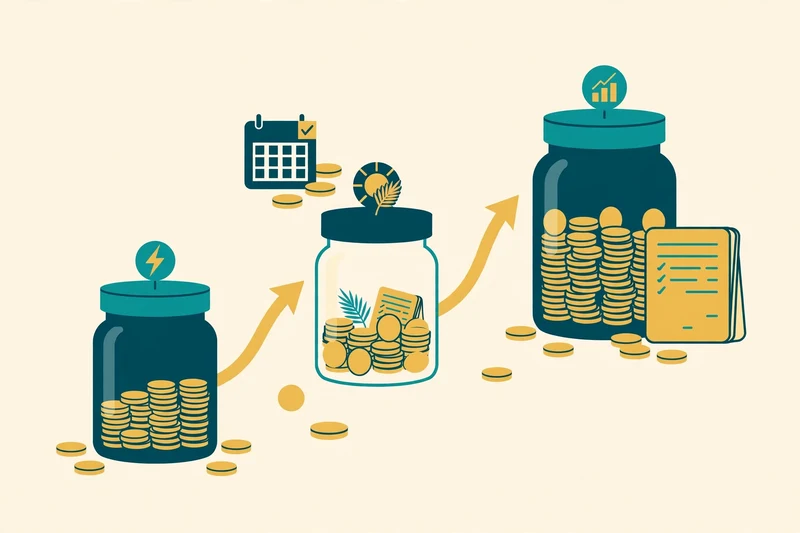
Start with the date, not the rate. Money you might need this month belongs in a high-yield or traditional savings account you can reach without penalty. Money with a fixed date a year or more away is a CD candidate. Money you want to keep earning interest while writing the occasional check points to a money market account. Money already sitting in a brokerage can stay productive in a cash management account.
Then check three practical details. First, fees and minimums: a no-fee account beats a slightly higher rate on a small balance. Second, transfer speed: an online account that takes two days to reach checking needs a checking buffer behind it. Third, insurance: deposits at FDIC-insured banks are covered up to $250,000 per depositor, per insured bank, for each account ownership category, according to the FDIC's deposit insurance guide — credit unions carry equivalent cover through the NCUA.
You need not use just one account: our guide to starting multiple savings accounts covers the bucket strategy, and a sinking fund inside an accessible account often suits a single dated goal.
Fees, rate changes and other watch-outs
Three traps catch savers more often than a low rate. Tiered rates pay the advertised rate only above a threshold balance, so check which tier your money falls in. Promotional rates expire, and the ordinary rate may be far lower. And some banks charge for withdrawals beyond a monthly count or for falling below a minimum — the fee schedule, not the headline rate, decides what you keep.
This article is general information only and is not financial advice. Rates, fees and insurance rules vary by institution and change over time — check the bank's current disclosure before opening any account.