Should I Refinance My Mortgage? The Rules of Thumb That Decide It
Every homeowner asks it when rates move: should I refinance my mortgage? Two classic rules of thumb — the 1% rule and the break-even rule — answer most of it. Here is how each one works, with the maths checked step by step:
Key takeaways
- The 1% rule: consider refinancing when you can shave a full point off your rate — a handy screen, not a law.
- The break-even rule actually decides: closing costs ÷ monthly savings; only refinance if you stay past that month.
- Planning to sell? Move before break-even and the refinance loses you money.
- Refinancing to pay off debt turns unsecured debt into debt secured by your home — usually a bad trade.
The 1% rule: a useful shortcut, not a law
The most quoted rule of thumb is the 1% rule: think about refinancing when you can cut your rate by at least one full percentage point. A full point usually generates enough monthly savings to recover the closing costs within a sensible couple of years, so it works as a quick first filter (Bankrate’s when-to-refinance guide).
But it is a shortcut, not a law. What matters is the dollar savings: a one-point cut on a $450,000 balance moves the payment far more than on a $140,000 balance, so advisers sometimes use 0.75% or 2% instead. Treat the 1% rule as the screening question — “is this worth a closer look?” — and let the next rule give you the answer.
The break-even rule: the one that actually decides
Refinancing is never free. Freddie Mac puts typical refinance closing costs at roughly 3% to 6% of the loan principal (BestMoney’s 2026 refinance guide, citing Freddie Mac). The break-even rule turns that cost into a date: break-even months = total closing costs ÷ monthly payment savings. Every month you keep the loan past that point is profit; before it, you are still paying the refinance off.
One caveat: a refinance starts a brand-new loan term, so part of a lower payment can come from restarting the 30-year clock rather than the cheaper rate. The rule is most honest comparing like with like — run your own quote through our refinance calculator instead of trusting any rule alone.
Worked example: a $350,000 refinance at today’s rates
Say you owe $350,000 at 7.75% and a lender offers 6.75% — a clean one-point drop. The principal-and-interest payment comes from the standard amortisation formula, P×r(1+r)n ÷ ((1+r)n−1), with r = annual rate ÷ 12 and n = 360. At 7.75% that is $2,507 a month; at 6.75% it is $2,270 — saving about $237 a month.
Now apply the break-even rule. With $5,000 in closing costs (about 1.4% of the balance): $5,000 ÷ $237 ≈ 21 months. Stay longer and the refinance pays you back, then keeps paying. Freddie Mac’s weekly survey averaged 7.28% on the 30-year fixed for the week ending October 1, 2026 (Freddie Mac PMMS) — see our rate picture for this week.
Should I refinance my mortgage if I plan on selling?
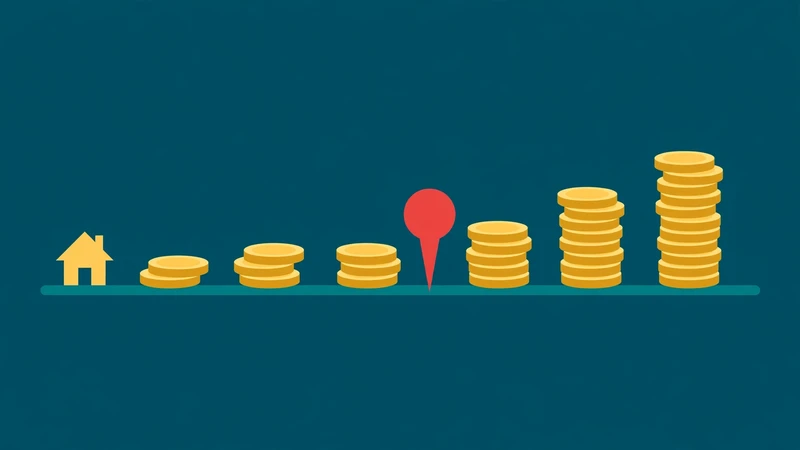
On the example above, break-even takes 21 months. Sell at month 12 and you have paid $5,000 in closing costs against roughly $2,844 of savings — a net loss of about $2,156.
Only refinance if your sale date is comfortably past break-even. If the move is uncertain, a “no-closing-cost” refinance shrinks the downside — though those deals just roll the costs into a higher rate or balance. See our closing-cost breakdown.
Should I refinance my mortgage to pay off debt?
A cash-out refinance — borrowing more than you owe to clear credit cards — tempts when card rates sit near 24% and mortgage rates near 7%. But it converts unsecured debt into debt secured by your home: fall behind and foreclosure enters the picture.
The track record is sobering. A 2025 CFPB study found 57.2% of cash-out borrowers with card balances saw them drop by 10% or more right after refinancing — but balances started climbing again after about five quarters, leaving many with fresh card debt on top of a bigger mortgage (Investopedia’s review of the CFPB data). It works only with a huge rate gap, steady income, and the discipline to never touch the cards again.
Three more rules worth knowing
ARM to fixed. If you hold an adjustable-rate mortgage and rates are rising — or you now plan to stay for years — locking a fixed rate buys certainty even without a big rate drop. Shorten the term. Going 30-year to 15-year raises the payment but slashes lifetime interest: on $350,000, total interest falls from roughly $553,000 to $202,000. Streamline. VA IRRRL and FHA streamline refinances skip the appraisal and most paperwork — but only if you already hold that loan type. And “no-closing-cost” never means no cost: you pay it in the rate or the balance.
One more screen before you commit: the credit and equity bar. Conventional refinances generally want a credit score of at least 620 — and the best rates go to scores around 740 and above — plus enough equity that the new loan’s LTV keeps you out of PMI territory. A refinance that drops your rate a full point but adds PMI back, or that lands you a worse rate because your score slipped since you bought, can quietly erase the whole saving. Check both before you pay for an appraisal.
The 1% rule tells you when to look, the break-even rule tells you whether to act, and the selling and debt cases tell you when to walk away. Run your own numbers with our refinance calculator — and see our PITI guide for the full monthly picture.