What Is a Trust? A Plain-English Guide to How It Works
A trust is a legal arrangement that lets one person hold and manage assets for someone else's benefit — and its three roles are the key to the whole idea.

Key takeaways
- The trustee holds legal title; the beneficiary receives the benefit.
- The grantor creates and funds the trust; the trustee manages it.
- Revocable trusts keep control; irrevocable trusts trade control for protection and possible tax advantages.
- Living trusts start in life; testamentary trusts start after death, via a will.
- Funding makes a trust real: an asset never retitled into it is not controlled by it.
A trust, in plain English
So, what is a trust? At its simplest, it is an arrangement in which one person or institution holds assets for another person's benefit. The creator writes the rules in a document called the trust agreement. The key idea is a split: the trustee holds legal title, but must use the assets for the beneficiaries. Cornell Law Institute's legal dictionary describes a trust similarly, as a relationship in which one party holds property for another's benefit (Cornell Law Institute). That split lets a trust manage assets for a young child or keep a home's management steady during incapacity.
The three roles: grantor, trustee, beneficiary
Every trust has three roles, though not always three different people. The grantor — also called the settlor or trustor — creates the trust and sets its terms. The trustee manages the assets under those terms,. The beneficiary receives the benefit: income, support payments, a place to live, or eventually the assets themselves. Their powers differ: the grantor's is mostly at the start, the trustee's is ongoing but bounded by a fiduciary duty to the beneficiaries, and the beneficiary can hold the trustee to account. SmartAsset puts it neatly: the grantor funds the trust, the trustee manages it, and the beneficiary receives its benefits (SmartAsset).
In practice the roles often overlap. In a typical revocable living trust, the grantor is also the first trustee and main beneficiary during life, so naming a successor trustee is one of the most consequential choices in the document. A trustee can also be a beneficiary, common with an adult child managing a family trust, but that needs careful drafting, as explained in our guide to whether a trustee can also be a beneficiary.
Revocable vs irrevocable: the control trade-off
The most important fork in the road is whether a trust can be changed. A revocable trust can be amended or revoked by the grantor during life: the grantor keeps control and can add or remove assets. The trade-off: the assets generally stay in the grantor's taxable estate and remain reachable by creditors. An irrevocable trust generally cannot be changed once created, except in narrow circumstances; the grantor gives up control to an independent trustee, but the assets are usually removed from the taxable estate and gain stronger creditor protection. A revocable trust normally becomes irrevocable at the grantor's death.
Living vs testamentary: when the trust starts
A second distinction asks when the trust comes into existence. A living trust is created during the grantor's lifetime, can manage assets during incapacity, and assets properly held in it generally pass without probate — one reason living trusts are discussed alongside ways to avoid probate. A testamentary trust is created by a will and only comes into existence after the grantor's death, once the will has gone through probate; because it is born from a will, it is irrevocable from the start. It cannot help during life, but it can hold assets for young beneficiaries until a chosen age.
Funding: the step that makes a trust real
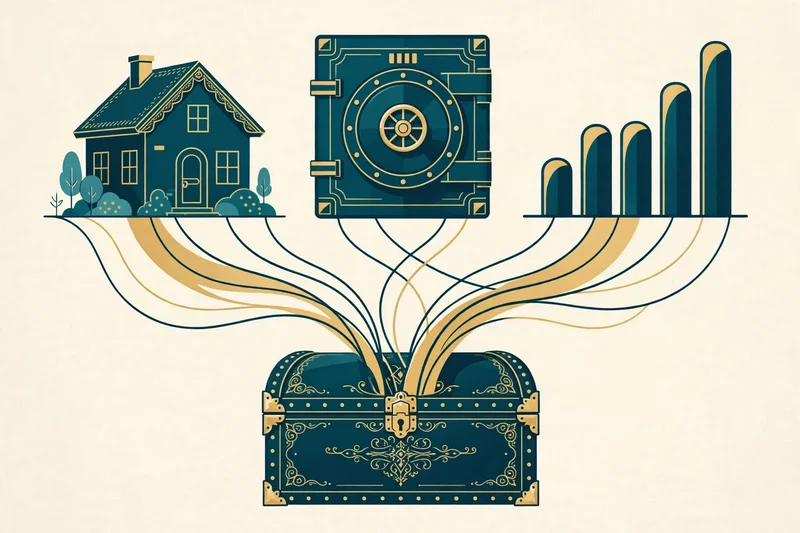
The most common misunderstanding about trusts is that signing the document puts assets into the trust. It does not. Funding is the separate job of retitling assets into the trust's name, such as recording a new deed or changing account ownership. Until that happens, the trust is an empty container. An unfunded trust controls nothing.
Consider a concrete illustration. Suppose a grantor funds a revocable living trust with a house worth $350,000, a brokerage account worth $60,000, and a bank account worth $25,000. Together they come to $435,000 ($350,000 + $60,000 + $25,000 = $435,000), and that is what the trust actually controls. But a retirement account naming a spouse directly as beneficiary, and a car never retitled into the trust's name, are neither part of the $435,000 nor controlled by the trust: the first passes under its own designation, the second outside the trust, possibly through probate. A trust's power extends exactly as far as its funding, so review titles after signing, and again after buying new assets.
What a trust does not do by itself
A trust is powerful, but it is not a complete estate plan on its own. It does not decide medical care during incapacity or who raises minor children. A revocable trust alone does not shield assets from creditors or cut the tax bill, because the grantor still controls the assets, and an unfunded trust does not avoid probate for assets left outside it. How much a trust costs, and whether it can be created without a lawyer, are covered in our guides to trust setup costs and setting up a trust without an attorney. Whether a trust or a will fits a family better is explored in our companion article on who needs a trust instead of a will.
The bottom line
A trust is, at heart, instructions wrapped around assets: a grantor writes the rules, a trustee carries them out, and beneficiaries receive the benefit. Revocable trusts preserve flexibility; irrevocable trusts trade it for protection and tax treatment. Living trusts start now; testamentary trusts start after death, through a will — and neither works until assets are moved inside. Above all: a trust only controls what has been funded into it. This article is general information, not legal or tax advice; rules vary by state, and the IRS provides general guidance on estate and gift taxes (IRS). For a tailored plan, an estate-planning attorney in your state is the right next step.