What Happens If You Don't Pay Property Taxes in 2026
What happens if you don't pay property taxes? The debt grows fast, a tax lien outranks your mortgage, and — one to three years later — your home can be auctioned. Here is each stage, and how to stop it.

Key takeaways
- Penalties start the day after the deadline: ~2–10% of the bill, then ~1–1.5% interest a month.
- The unpaid bill becomes a tax lien with “superpriority” — it outranks your mortgage.
- After one to three years unpaid, the county can sell the lien or the property at a tax sale.
- Redemption windows let you buy it back — payment plans and exemptions are cheaper if you act early.
Penalties start the day after the deadline
The meter starts the morning after your due date: a flat late penalty of roughly 2% to 10% of the bill, then interest of 1% to 1.5% a month. In some areas the annual rate reaches 18% or more — one of the priciest debts you can carry.
Fees pile on too — notices, lien recording, auction paperwork — and every dollar added accrues its own interest. A few counties offer a one-to-two-week grace period; many don't. Never plan around one.
The tax lien jumps ahead of your mortgage
Once the bill goes delinquent, a tax lien attaches automatically, by operation of law. In virtually every state it has “superpriority”: it ranks ahead of every other claim, including your mortgage. If the home is sold to satisfy the tax debt, the government is paid before your lender.
That's why your mortgage servicer takes delinquent taxes personally. Most contracts require you to keep taxes current, so the servicer can pay the county itself and bill you. Fail to reimburse it and you're in breach — a breach that can trigger foreclosure, often faster than the tax process.
The penalty math on a $5,000 bill: a Texas example
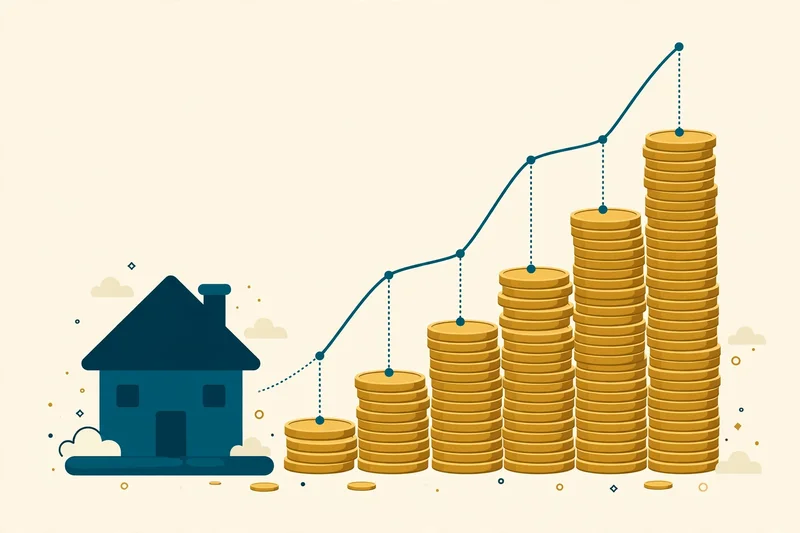
Texas publishes the clearest schedule. On a $5,000 bill unpaid past January 31, a 6% penalty ($300) plus 1% interest ($50) hits on February 1 — $350 at once. Each month adds another 1% penalty and 1% interest; on July 1 the penalty caps at 12% ($600), but interest keeps climbing with no maximum. By December 1 the add-ons total $1,150, pushing the balance to $6,150.
The last sting: a collection attorney can add a penalty of up to 20% of the total owed — up to $1,230 more, for a total as high as $7,380. That's about 48% above the original bill after eleven months. Schedules differ by state, but the pattern holds: the longer you wait, the more the debt feeds itself.
The tax sale: lien sales vs. deed sales
When collection fails, the county auctions the debt in one of two forms. In a tax lien sale, the government sells the right to collect to an investor; you keep the title and get a redemption period. In a tax deed sale, the property itself is sold. New York City uses the lien model — a lien can be sold once ~$5,000 sits unpaid for over three years — while Texas lets taxing units foreclose the lien and sell the home. These auctions feed the same market covered in our guide to buying foreclosed homes.
Your last protection is redemption: most states give six months to four years after a lien sale to reclaim the property by paying everything owed in one lump sum. Miss the window and the sale is final. One safeguard is now nationwide: in Tyler v. Hennepin County (2023), the Supreme Court ruled the government must return any surplus to you — though you usually must file a claim, and the deadline is short.
What it does to your credit score
Good news first: an unpaid tax lien no longer appears on your credit reports. Equifax, Experian, and TransUnion stopped reporting tax liens entirely by April 2018. So the lien won't directly drag down your score the way a foreclosure would.
But the lien stays public record. Non-bureau checks can still surface it, underwriters ask about delinquent taxes directly, and no clean title means no sale or refinance. If you sell the home yourself to stay ahead, know what the sale nets you — including the closing costs sellers pay.
Relief options if you can't pay the full bill
Every state offers some property tax relief, and the cheapest options come before delinquency. A homestead exemption cuts the taxable value of your primary residence, and nearly every state offers one. Seniors, veterans, and disabled owners often qualify for extra exemptions or freezes — but most require an application, so apply early.
Already behind? Call your county treasurer anyway. Many counties offer installment plans before a sale is scheduled, and some states offer deferrals — the tax becomes a lien-like debt you settle when you sell. If the math never works, selling yourself before a tax sale preserves far more equity than any auction.
The simplest prevention: let escrow handle it
If you have a mortgage, the simplest fix is an escrow account: your servicer collects roughly one-twelfth of your annual tax bill with each payment and pays the county for you. Our guide to how mortgage payments bundle taxes and insurance shows how that figure is built — escrow turns one dangerous deadline into twelve forgettable ones.
Bottom line
Unpaid property taxes are cheap to prevent and brutal to ignore. Penalties compound, the lien outranks your mortgage, and the end of the road — one to three years out — is a forced sale of your home. But before that sale, you have moves: exemptions, payment plans, deferrals, or selling on your own terms. The worst option is waiting for the next notice. Call your tax collector this week.
Curious how these auctions look from the other side?
Our guide to buying foreclosed homes explains how forced-sale auctions actually work.
Read the foreclosure guideSources & further reading
- NoloLien priority, sale types, redemption, Tyler ruling (curl: 200, 23 Oct 2026).
- LegalClarityPenalty ranges (2–10%, 1–1.5%/mo), superpriority, servicer risk (curl: 200, 23 Oct 2026).
- Texas Comptroller of Public AccountsTexas penalty/interest schedule, up to 20% collection penalty (curl: 200, 23 Oct 2026).
- Brick UndergroundNYC lien-sale thresholds: ~$5,000, 3+ years (curl: 200, 23 Oct 2026).
- CMG Home LoansBureaus dropped tax liens from reports by April 2018 (curl: 200, 23 Oct 2026).
- CFPBEscrow collecting taxes with monthly payments (curl: 200, 23 Oct 2026).