NHS Dental Costs: Bands 1, 2 and 3 Explained for 2026/27
Most adults in England pay one of three NHS dental charges. Here are the 2026/27 bands, what each covers, and who pays nothing.

Key takeaways
- NHS dental treatment in England costs £27.90, £76.60 or £332.10 per course (Bands 1, 2, 3), from 1 April 2026.
- You pay once per course, at the highest band involved.
- Urgent treatment costs £27.90, the same as Band 1.
- Under-18s, pregnant women, new mothers and people on certain benefits pay nothing.
- Low income? The NHS Low Income Scheme can cut or remove the charge.
The three NHS dental bands at a glance
NHS dental treatment in England is priced in three bands: you pay the band, not the item. These are the current charges on the NHS website, in force from 1 April 2026. The previous year they were £27.40, £75.30 and £326.70.
- Band 1: £27.90. Examination, advice, X-rays if needed, fluoride, and simple gum treatment.
- Band 2: £76.60. Band 1 plus fillings, root canal treatment, extractions and oral surgery.
- Band 3: £332.10. Bands 1 and 2 plus crowns, dentures, bridges and clinically necessary orthodontics.
- Urgent treatment: £27.90. An urgent appointment, charged at the Band 1 rate.
England only; the other UK nations run their own systems, covered below.
Band 1: £27.90, the check-up band
Band 1 is the routine appointment charge: examination, assessment and advice, X-rays if needed, fluoride, simple gum treatment such as scaling, moulds, and minimal denture or brace adjustments.
Scaling is the item people query most: if clinically needed it is usually in Band 1. Extensive gum treatment may be Band 2, and non-essential scaling is private.
Band 2: £76.60, fillings, root canals and extractions
Band 2 adds fillings, root canal treatment, extractions and oral surgery to Band 1, plus sealants, denture additions and extensive adjustments, a non-laboratory bite-raising appliance, and extensive gum management.
White fillings are available when clinically necessary: a front tooth may get one, a back tooth an amalgam one. Wisdom teeth can be removed on the NHS when clinically necessary.
Band 3: £332.10, crowns, dentures and bridges
Band 3 adds crowns, inlays and onlays, dentures, bridges, braces, and other custom-made appliances, not sports guards.
You may be offered a metal-coloured crown on a back tooth. Braces are available only if clinically necessary.
Urgent dental treatment: £27.90
In pain or injured? An urgent appointment costs £27.90, or nothing if exempt. It covers an examination, X-rays, a temporary filling, emergency root canal treatment, a knocked-out tooth, refixing a crown or bridge, removing up to two teeth, draining an abscess and aftercare. It deals with the immediate problem only.
Two rules that decide what you actually pay
Two rules decide how much you actually pay, and both work in your favour.
One charge per course. Mixed bands? You pay the highest band once: a check-up, two fillings and a crown is one Band 3 charge of £332.10.
The two-month rule. Further treatment within two months in the same or a lower band is free; higher, you pay that fee. After two months it is a new course.
Stitches removal, stopping bleeding and denture repairs are free for all NHS patients.
Who gets free NHS dental treatment
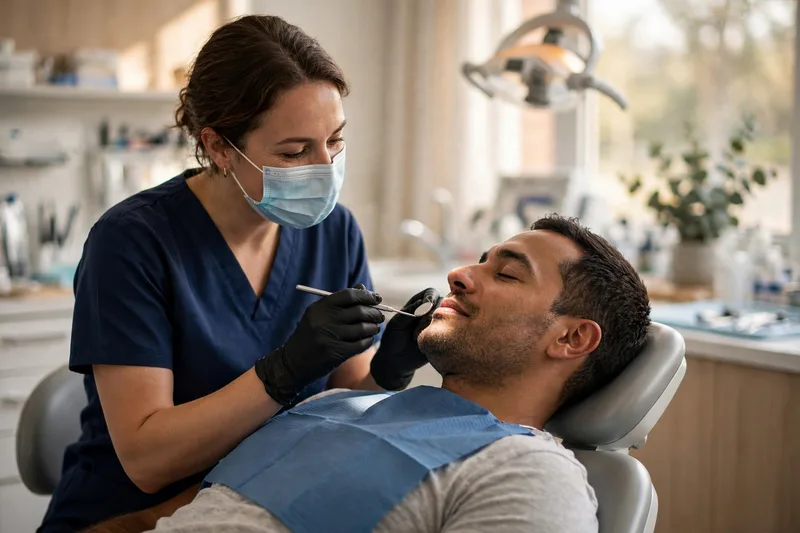
Some people pay nothing in England. You qualify if, when treatment starts, you are under 18, or under 19 in full-time education; pregnant, or had a baby or a stillbirth in the last 12 months; treated in an NHS hospital by a hospital dentist; or receiving War Pension or Armed Forces Compensation Scheme payments for your accepted disability.
You also qualify if you or your partner receive income-related Employment and Support Allowance, Pension Credit Guarantee Credit, or Universal Credit below the earnings limit: £435 of take-home pay in your last assessment period, or £935 with a child or limited-capability-for-work element. Our guide to what Universal Credit is explains it in full. Dependents under 20 also qualify.
Personal Independence Payment alone does not exempt you, but many PIP claimants also receive Universal Credit or income-related ESA, and then the benefit route above may apply. Our guide to how to claim PIP explains that benefit. Take proof, such as an HC2 certificate or maternity exemption certificate: claiming wrongly can bring a fine.
Help with costs if you are on a low income
Not exempt but on a low income? Apply to the NHS Low Income Scheme with form HC1, from a Jobcentre or online. Success brings an HC2 for free treatment, or an HC3 showing what you will pay. Already paid but entitled to free or part-paid treatment? You may claim a refund, so keep receipts.
NHS dental costs outside England
Bands above are for England only. Wales moved to care packages on 1 April 2026: urgent care £37.50, a new patient assessment £27.21, a recall £25.00, a £384 maximum per course, and free examinations under 25 or 60 or over. Scotland and Northern Ireland differ again: check NHS Inform or nidirect.
NHS vs private dental treatment
The NHS covers clinically necessary treatment: check-ups, fillings, root canals, extractions, crowns and dentures. Cosmetic work, such as whitening, is not covered.
Private fees are set by each practice and are usually higher than the NHS band. A private practice must give you a plan and price before starting, as an NHS dentist must give you the band charge. If offered private treatment, ask for the full price in writing first. NHS places are not always easy to find: use the NHS find-a-dentist service.
Worked example: what a full course can cost
Worked example, labelled illustrative. A check-up finds two fillings are needed, and the same course adds a crown: separately that is £27.90 plus £76.60 plus £332.10, or £436.60. Under NHS rules you pay once, at the highest band: £332.10, £104.50 less, and a crown adjustment within two months is free.
Sources & further reading
- NHS, How much NHS dental treatment costsVerified 10 Nov 2026.
- NHS, Free NHS dental treatmentVerified 10 Nov 2026.
- GOV.UK, Get help with NHS costsVerified 10 Nov 2026.
- NHSBSA, Check your eligibility for helpVerified 10 Nov 2026.
- GOV.WALES, NHS dental charges and exemptionsVerified 10 Nov 2026.
- NHS, How to find an NHS dentistVerified 10 Nov 2026.
This article is general information only, not financial advice.