How Long Does It Take to Close on a House?
How long does it take to close on a house? For a financed purchase, 30 to 45 days from accepted offer to closing day is the normal range. All-cash buyers move faster — sometimes under two weeks. Here is what fills those weeks, what can stretch them, and how to keep your closing on schedule.
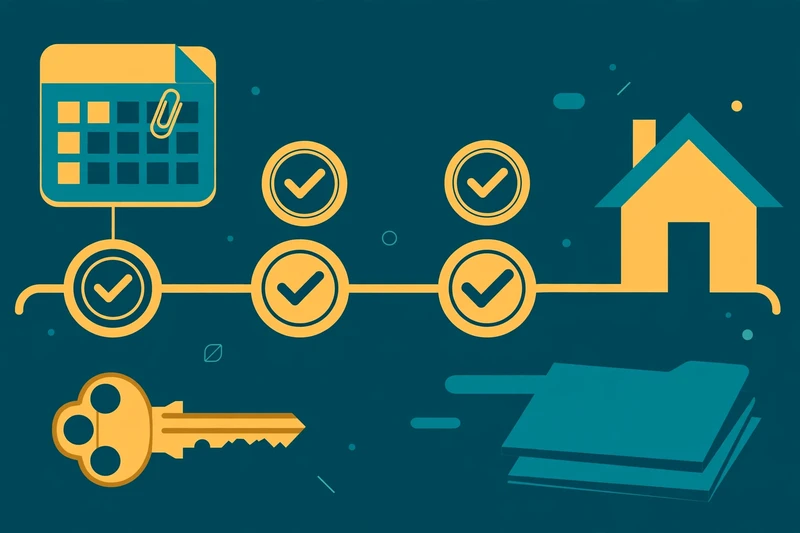
Key takeaways
- Most financed purchases close 30 to 45 days after the offer is accepted; a widely cited industry study puts the average near 50 days.
- All-cash deals skip the lender entirely and can close in about two weeks.
- The longest stretch is usually lender due diligence — around 30 days for a conventional loan once the offer is in.
- By federal rule, you must receive the Closing Disclosure at least three business days before closing.
- The most common cause of delay is financing trouble, followed by low appraisals, insurance delays and title issues.
The short answer: 30 to 45 days is normal
If you are asking how long it takes to close on a house because you have an offer in and a calendar to plan around, here is the number to anchor on: 30 to 45 days from accepted offer to closing day, when a mortgage is involved. Realtor.com, citing an industry study, notes that average closing times have crept up to around 50 days — so a six-week contract is roughly the market norm.
That clock starts the day the seller accepts your offer, not the day you start house hunting or get pre-approved. And it assumes a financed deal with a conventional loan. Government-backed loans — FHA and VA — often need a few extra days for their own appraisal and condition requirements. Your purchase contract will name a specific closing date, and hitting it depends on everything below lining up on schedule.
Your week-by-week closing timeline
Here is what typically fills those weeks between “offer accepted” and “keys in hand”:
- Week 1 — offer, earnest money, inspection. You deposit earnest money, and the inspection happens inside the contingency window (often 7–10 days) — this is the week you negotiate any repairs or credits the inspection turns up.
- Weeks 2–3 — appraisal and title. Your lender orders the appraisal, and the title company searches the property’s history for liens, claims or paperwork errors. Meanwhile you shop for homeowner’s insurance — your lender will require it before closing.
- Weeks 3–5 — underwriting. This is the longest phase. The underwriter verifies your income, assets, employment and debts, then issues “conditions” — extra documents or explanations you must supply. Realtor.com notes that even with a pre-qualification, a conventional lender can take about 30 days to complete this due diligence once the offer is made.
- Final week — disclosure, walkthrough, funding. You receive the Closing Disclosure at least three business days before closing, do a final walkthrough of the property, then sign. Funds are wired, the deed is recorded, and the keys change hands.
The Closing Disclosure is the document that itemises your loan terms and closing costs — compare it line by line against the Loan Estimate you received earlier. If the APR moves by more than an eighth of a point, a prepayment penalty appears, or the loan product changes, the lender must issue a new disclosure and the three-day clock restarts, per the CFPB. That is the main way the federal waiting period can push a closing date back.

How much faster is an all-cash closing?
Cash buyers skip the entire lending apparatus — no application, no underwriting, no lender-ordered appraisal. Realtor.com notes that all-cash buyers save a significant amount of time by avoiding the mortgage process altogether. In practice, an all-cash closing can finish in about two weeks, sometimes less: the remaining work is the title search, any inspection you still want, and moving the money.
Title insurance and proof of funds still matter, so it is not instant — but it is roughly half the timeline of a financed deal.
What can slow a closing down
Even with a mortgage secured and a property under contract, closings slip. Realtor.com’s reporting lines up with what agents see every week:
- Financing trouble is the single most common cause — a snag in final approval, a job change mid-process, or new debt taken on after pre-approval.
- Appraisal gaps: if the appraisal comes in below the price, the price must be renegotiated or the loan reworked — both take time.
- Insurance delays: homeowner’s insurance is usually a loan requirement, and sorting it out at the last minute slows everything down.
- Contingencies: a buyer who must sell their current home first, or a seller who needs to find their next place, can push the date.
- Title problems: liens, boundary disputes or paperwork errors found in the title search need resolving before anyone signs.
Sellers feel these delays too — and they carry their own share of the bill while they wait. Our guide to typical closing costs for sellers breaks down what they pay at the table.
How to keep your closing on schedule
- Get a real pre-approval, not just a pre-qualification, before you offer — sellers increasingly require it, and it surfaces problems early.
- Answer lender “conditions” the same day they arrive. Underwriting stalls when documents sit in your inbox.
- Do not change jobs, open new credit cards or finance a car during the process. Lenders re-verify employment and pull credit again before closing.
- Line up homeowner’s insurance early, not in the week of closing.
- While the lender works, review how to reduce closing costs so the number on the Closing Disclosure does not surprise you.
- Communicate through your agent or attorney the moment something looks off — late changes mean new forms and new review periods.
Run your own numbers so you know exactly what payment you are signing up for: our mortgage calculator shows principal, interest, tax and insurance on any price and rate.
Try it yourself
Know your closing date? Work backwards: plug your price, down payment and rate into the mortgage calculator.
Open the mortgage calculatorSources & further reading
Timelines reflect current industry reporting; payment maths is our own.
- Realtor.com — How Long Does It Take to Close on a House?Industry reporting on average closing times (around 50 days in a recent study), the roughly 30-day lender due-diligence window, and the most common causes of delay.
- Consumer Financial Protection Bureau — Why is there a waiting period before my mortgage closing?The CFPB explains the federal waiting-period rules that protect borrowers before closing.
- Consumer Financial Protection Bureau — The three-business-day Closing Disclosure ruleWhen the Closing Disclosure must reach you, and which loan changes restart the three-day clock.