How Does Home Equity Work?
Your equity is the slice of your home you actually own — value minus what you owe. Here is how that slice grows, the 80% rule that limits what you can borrow, and the three ways to turn it into cash.
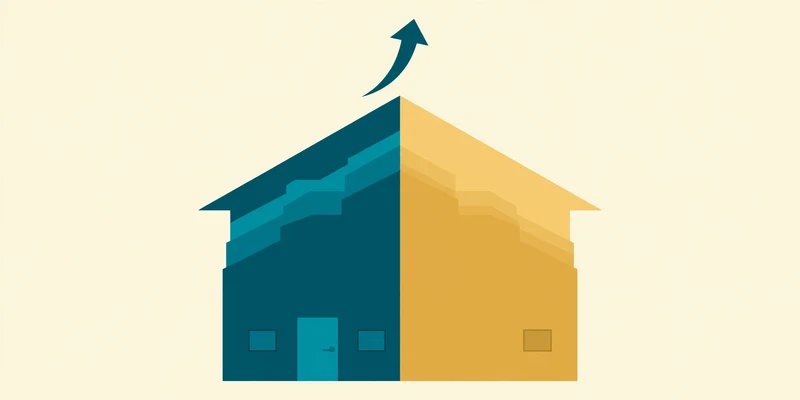
Key takeaways
- Home equity = current market value minus everything you owe on the home. It is the portion you truly own.
- Equity grows through two engines: paying down principal and home-price appreciation — you do not control the second one.
- Most lenders cap total borrowing at 80% of the home’s value (the 80% CLTV rule): on a $400,000 home with $280,000 owed, about $40,000 is borrowable.
- The three ways to tap it — HELOC, home equity loan, cash-out refinance — differ in structure, rate type, and cost; none of them is free money.
- In October 2026, HELOCs average about 7.36% and fixed home equity loans about 7.76%–8.6%, with closing costs of 2–5% of the loan amount.
Home equity is simply value minus what you owe
Strip away the jargon and the formula fits on one line: home equity = current market value − all loans secured by the home. That includes your first mortgage plus anything else using the house as collateral — a second mortgage, an existing HELOC balance, any liens. As Marcus by Goldman Sachs puts it, equity is the portion of the home you own outright; the lender owns the rest until the loan is paid off.
Take the example we will use throughout this guide: your home appraises at $400,000 and you owe $280,000, so your equity is $120,000 — 30% of the home. Note it uses today’s market value, not what you paid.
How equity gets built: the two engines
Engine one: paying down principal. Every payment splits into interest and principal; over time, amortization shifts more of each payment toward principal, so equity builds faster in the loan’s later years. Run the numbers on a mortgage calculator to see how a single extra payment a year shortens the timeline.
Engine two: appreciation. When home values rise, your equity rises with them even if your loan balance never moves. This engine built enormous equity for homeowners over the past decade — it is also the one you do not control. Renovations can raise appraised value, but values can also fall — which is exactly why lenders refuse to let you borrow all of it.
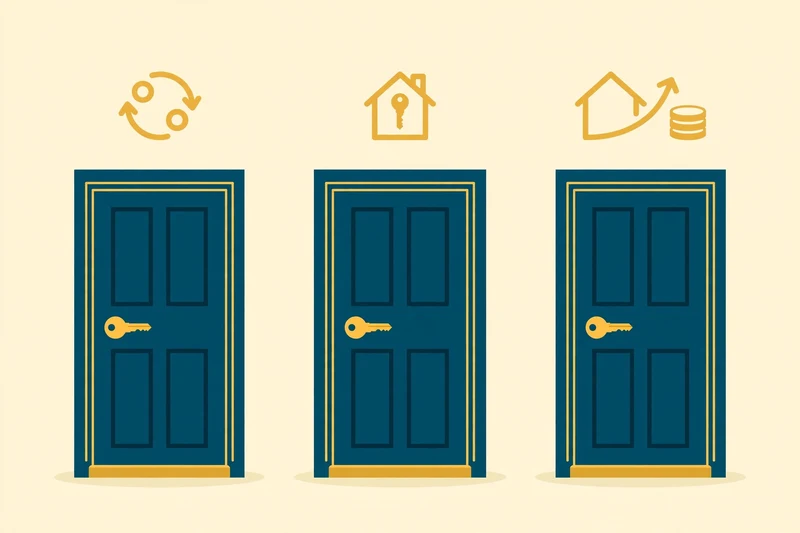
The 80% rule: how much you can actually borrow
Here is the part that surprises first-timers: you cannot borrow your full $120,000 of equity. Most lenders cap your combined loan-to-value ratio (CLTV) — your first mortgage plus the new borrowing, divided by the home’s value — at 80%.
The arithmetic on our example:
| Step | Math | Result |
|---|---|---|
| Home value | appraised value | $400,000 |
| Maximum total debt at 80% CLTV | $400,000 × 0.80 | $320,000 |
| Minus existing mortgage | $320,000 − $280,000 | $40,000 available |
| Total equity | $400,000 − $280,000 | $120,000 |
So of the $120,000 in equity, roughly $40,000 is borrowable under the standard rule. Some lenders stretch to 85–90% CLTV at higher rates, but the safety cushion shrinks.
Three ways to turn equity into cash
1. HELOC (home equity line of credit). A revolving credit line secured by your home: draw what you need during a ~10-year draw period, with a variable rate tied to prime. You often pay interest only during the draw period, then principal-and-interest begins. Best for ongoing or unpredictable costs.
2. Home equity loan. A one-time lump sum with a fixed rate and fixed payments over 5 to 30 years — often called a second mortgage. You pay interest on the whole amount from day one, so borrow only what you need. Best for a single known expense, like a roof replacement with a firm bid.
3. Cash-out refinance. You replace your entire first mortgage with a bigger one and pocket the difference. With most homeowners holding first mortgages well under today’s rates, refinancing the whole loan just to reach equity usually costs more than adding a second lien.
What borrowing against equity costs in 2026
Rates on equity products sit above first-mortgage rates because second-lien debt is riskier for the lender. Bankrate’s weekly survey put the average HELOC rate at 7.36% in the week of October 21, 2026. Experian, citing Curinos data, reported October averages of 7.67% for HELOCs and 7.76% for fixed home equity loans.
Then come the closing costs: appraisal, origination, title search and insurance, recording fees. LegalClarity’s 2026 breakdown pegs them at 2% to 5% of the loan amount — $800 to $2,000 on our $40,000 example. Ask for a Loan Estimate from every lender and compare total cost, not just the rate.
The tax question: when the interest is deductible
The IRS rule is strict and widely misunderstood. Per the IRS’s own guidance, home equity loan or HELOC interest is deductible only when the borrowed money is used to buy, build, or substantially improve the home that secures the loan — and only if you itemize deductions. Use the funds to consolidate credit cards, pay tuition, or take a vacation, and the interest is not deductible, period.
There is also a debt cap: the $750,000 total mortgage-debt limit ($375,000 if married filing separately) covers your first mortgage plus any equity borrowing combined. Our home improvements tax deduction guide walks through which projects count.
The risk nobody should skip
Every product in this guide puts your house up as collateral. Miss payments on a HELOC or home equity loan and the lender can foreclose — the same consequence as defaulting on your first mortgage, per NerdWallet’s home equity guide. That is the fundamental trade: equity borrowing is cheaper than credit cards precisely because the lender holds your home as the guarantee.
Borrow for things that build value or prevent larger losses — and think twice about funding consumption with it. And if your credit is shaky, the math changes: our guide to home equity loans with bad credit covers the realistic paths and their honest costs.
Building equity faster
If the 80% rule left you short, the fix is time plus principal: extra payments go straight to the balance, widening your equity slice and lowering your CLTV. Biweekly payments (26 half-payments = 13 full payments a year) are the classic autopilot version. Appraisals anchor to comparable sales, not to what you spent — so avoid over-improving for the neighborhood.